Akke Corporaal
Postdoctoral research Fellow at ESO Chile
Research projects
Post-Asymptotic giant branch (post-AGB) binaries are complex systems. These systems are a direct result of a recent, but poorly understood binary interaction. The general building blocks are a post-AGB primary star, a main-sequence secondary star, an accretion disc around the secondary, an outflow origination from this accretion disc, and a circumbinary disc. Here I briefly outline the recent projects I’ve been working on. You can find my publications here.
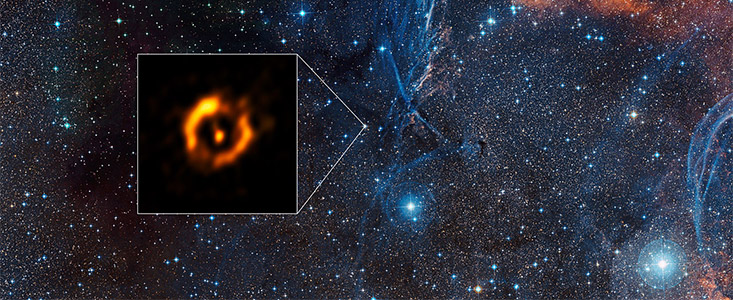
IRAS 08544-4431:
a bright benchmark target
Image reconstruction of IRAS08544-4431 in the sky. Image credit: ESO
IRAS 08544-4431 is a post-AGB binary system hosting a circumbinary disc that starts at the dust sublimation radius. I led the analysis of an infrared interferometric data set for this target with the aim to understand the circumstellar environment. The data set consisted of PIONIER (H band, ~1.65 micron), GRAVITY (K band, ~2.2 micron), and MATISSE (L band, ~3.5 micron and N band, ~8-13 micron) data, allowing to probe different regions in the inner disc. As such, we can have an idea on the physical processes at different radii in the disc. With PIONIER and GRAVITY we probe the inner disc rim, while with MATISSE we probe deeper in the disc.
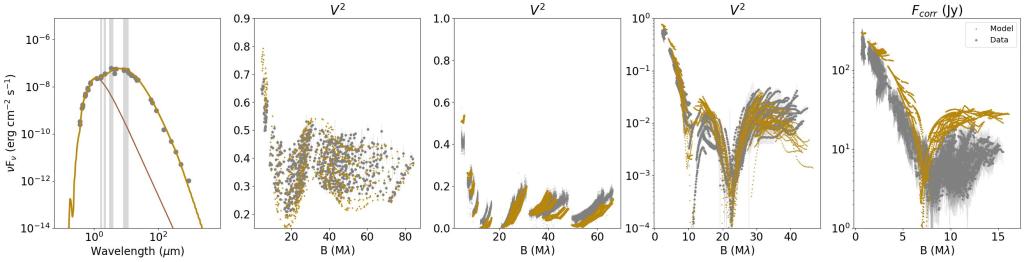
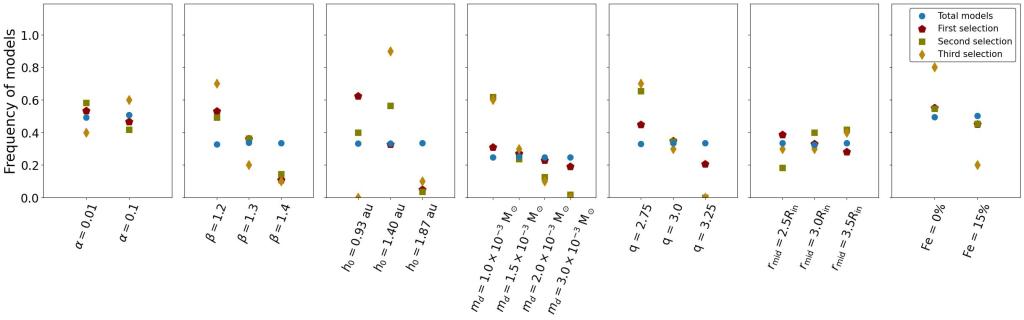
Modelling of time dependent asymmetries in progress. Stay tuned for updates in the near future.
To constrain the physical processes more, we are building and refining the physical model for this target, fitting simultaneously the photometry and the afore mentioned infrared interferometric observations. We developed a methodology to find the family of models that best reproduce the photometric and interferometric features, such as the star-to-disc flux ratio, the radial extents of the different bands and the amount of extended flux captured. We find a set of models that are able to reproduce most of these features. With our strategy, we found that we can constrain some of the disc parameters, such as the scale height parameters (beta and h0), the dust mass, the grain size distribution power law (q), and the presence (or absence) of metallic iron in the disc. One important ingredient is still missing; we cannot fully fit the over-resolved component, which is best seen in the very small baseline fit to the visibilities.

Transition disc hosting post-AGB binaries:
What are the cavity sizes and what causes these (large) cavities?
Artist’s impression of a post-AGB binary hosting a transition disc. Image credit: N. Stecki
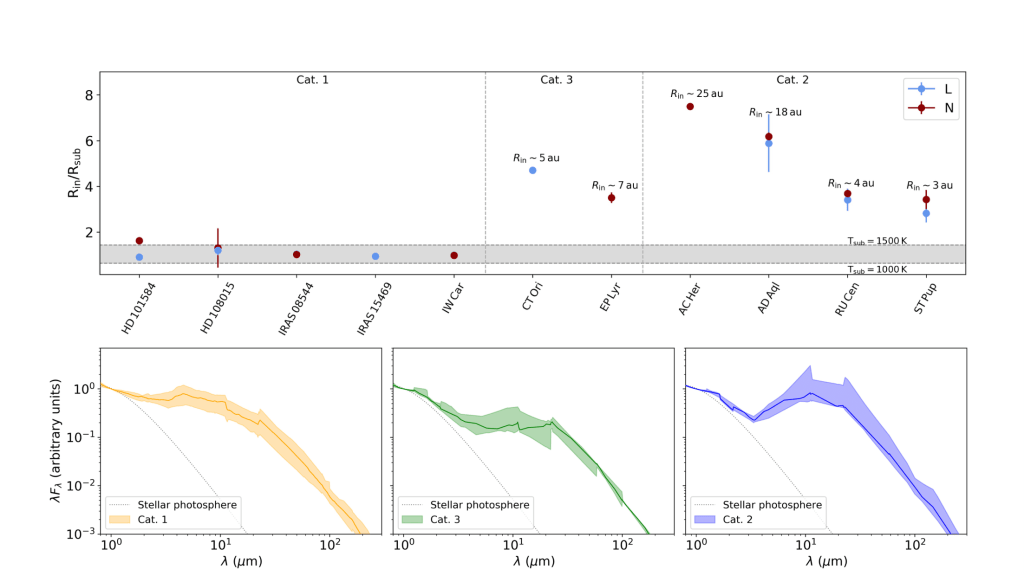
Recently it was discovered that there are indications that 10% of the post-AGB binary systems in our Galaxy host a disc with an inner large cavity in the dust distribution. Such transition discs are also found in young stellar objects. To see whether these post-AGB systems indeed host such discs, we use mid-infrared interferometric observations. I’m the PI of three successful proposals for VLTI/MATISSE data of such discs.
I modelled the obtained data using geometric modelling and resolved the size of the inner dust cavity. I compared those systems to five systems that are expected to host a full disc, based on both photometric properties and previous infrared interferometric observations. Indeed, we show that the six post-AGB systems that were proposed to host a transition disc have inner cavities of 2.5-7.5 times the dust sublimation radius. We therefore confirm the transition disc nature of circumbinary discs around post-AGB binary systems. Future studies need to reveal the structure and origin of these transition discs.

Full disc hosting post-AGB binaries:
Asymmetries in the inner regions? Common features and physics?
Artist’s impression of a post-AGB binary hosting a full disc. Image credit: N. Stecki
Work in progress: stay tuned for more images and models.
 Akke Corporaal